

Has a storm damaged your Texas home? Here’s what you need to know when making repairs.
Where do I start?
- Contact your insurance agent to find out if your repairs need to meet the International Building Code (IBC) or the International Residential Code (IRC). These rules apply if your home is in the first row of Texas counties bordering the Gulf of Mexico, or in one of the these cities in Harris County east of State Highway 146: La Porte, Morgan’s Point, Pasadena, Seabrook, or Shore Acres.
- If your insurance requires repairs meet the IBC or IRC, talk to your insurance agent or adjuster about the Windstorm Inspections Program.
- If the repairs are inspected and comply with the IBC or IRC, TDI issues a Certificate of Compliance, Form WPI-8, to Texas Windstorm Insurance Association (TWIA).
- Find more information on the Windstorm Inspections Program at tdi.texas.gov/wind or at by calling TDI at 800-248-6032, option 3.
- For building requirements in your area, contact your local building official.
How do I pick a contractor?
- Verify contractor’s name, address, telephone number, and references.
- Check that the contractor has insurance or a bond.
- Get at least three written bids to compare.
- Get a copy of all written, signed agreements, and warranty terms.
- If you need a WPI-8 form, verify the repair or replacement is eligible.
- Don’t make your final payment until the contractor finishes all work and a Certificate of Compliance, Form WPI-8, is issued by TDI for the work performed.
- Avoid contractors going door-to-door for damage repair work.
Are there any contractors I should avoid?
Watch out for contractors who:
- Aren’t familiar with the Windstorm Inspections Program.
- Only accept cash.
- Only have out-of-state references or don’t have a physical address in your area.
- Require money before materials are on site.
- Are not established.
- Don’t have insurance or a bond.
- Offer “specials” or “extra-cheap work.”
-
What siding product choices meet IBC or IRC standards?
Homeowners have several choices of siding material. Vinyl siding and fiber-reinforced cement are the most common siding materials for homes along the Texas coast. In high wind areas, make sure that your siding products have a published wind resistant rating.
To find the wind resistant rating of a siding product, see the product information or call TDI at 800-248-6032, option 3.
-
Is my wall sheathing okay, or should the contractor reattach or replace it after removing existing siding?
The contractor should check your wall sheathing and replace any deteriorated or damaged areas before installing new exterior siding.
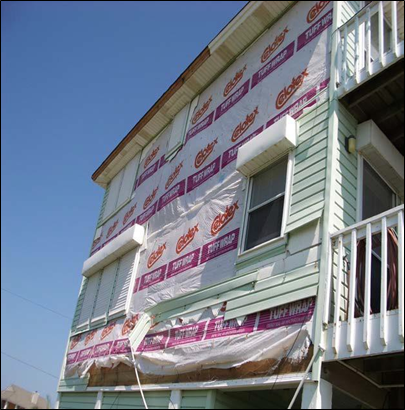
Your contractor should check your wall sheathing. -
Should the contractor apply weather resistant sheathing material to the wall before installing my siding?
Typically, the contractor should apply weather resistant material, such as asphalt felt or other approved weather-resistant materials, to the wall before installing most exterior siding products. The manufacturer’s installation requirements provide specific information on the type and fastening of the recommended weather resistant materials.
-
How should the contractor install siding products?
The contractor should install siding products in strict accordance with the manufacturer’s installation instructions and the evaluation report listing for the product. You can find the product information online or by calling TDI at 800-248-6032, option 3.
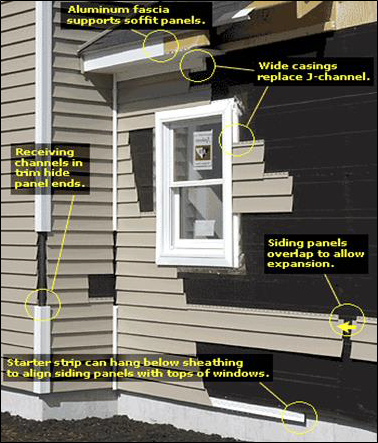
Follow manufacturer’s instructions during siding installation. -
What kind of fasteners should the contractor use to install my siding products?
Typically, siding products are installed using fasteners with a corrosion resistant coating, like nails. The contractor should use the fasteners specified in the evaluation report for the product. Fiber cement siding may be installed with the fastener heads exposed or concealed, according to the specific installation method in the manufacturer’s installation instructions. The contractor should properly install the fasteners and avoid underdriving or overdriving the fasteners.
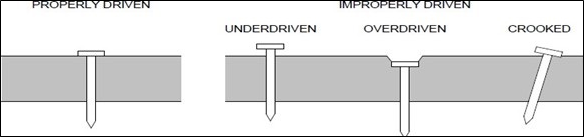
Properly and improperly driven fasteners in fiber cement siding.
In recent hurricanes, garage door failures contributed to 80% of home failures. A wind resistant garage door protects your home and personal property from catastrophic damages. This information helps you select a contractor to repair or replace your garage door after a storm.
-
What garage door choices meet IBC or IRC standards?
Homeowners have several choices for garage doors. Most major garage door manufacturers have product listings with TDI. In high wind areas, published wind resistant ratings for the garage door are important. If the garage door you select has glass panels, consider an impact resistant garage door. For help finding the wind and impact resistant ratings for garage door products, see the approved product information or call TDI at 800-248-6032, option 3.

Wind resistant ratings for garage doors are important. -
How should a contractor install the garage door?
Garage door assemblies must be installed in strict accordance with the manufacturer’s installation instructions and their tested high wind application. Typically, each approved wind resistant garage door has drawings associated with its installation. You can find approved product information online or by calling TDI at 800-248-6032, option 3.
A storm damaged my windows or doors — what should I know about repairing them?
Wind and impact resistant windows and exterior doors protect your home and your personal property from catastrophic damage. This information helps you choose a contractor to repair or replace your windows and/or doors after a storm.
-
What windows and exterior doors meet IBC or IRC standards?
Homeowners can choose several types of windows and exterior doors. TDI lists many product evaluations online.
Consider choosing impact resistant windows and exterior doors for extra protection. The IBC or IRC standards may require impact resistant shutter systems if you use non-impact resistant windows and exterior doors. For help finding wind resistant ratings and impact resistant requirements for windows and exterior doors, contact TDI Windstorm Inspections Program at 800-248-6032, option 3.

Window glass broken by windborne debris. -
If I replace my window or door, will I be required to install a shutter?
If the windows or doors need to meet IBC or IRC requirements, you may need a shutter.
You will need an impact resistant shutter for structures in areas where the wind speed is 140 mph and higher:
- If non-impact resistant windows are installed on a building in a windborne debris area as designated by the IBC and IRC standards.
- If non-impact resistant doors, with glazing, are installed on a building in a windborne debris area as designated by the IBC and IRC standards.
You can find information about TDI listed windows, doors, and shutters online or by calling TDI at 800-248-6032, option 3.
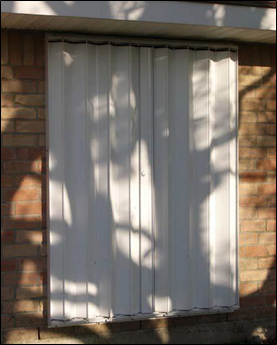
Impact resistant shutter system installed over a window opening. -
Can I use a Wood Structural Panel (WSP) as a shutter?
Yes, it may be possible to use WSP shutters. A WSP shutter is made from either plywood or oriented strand board (OSB). Your ability to use WSP shutters depends on many factors, including:
- The location of the building.
- The height of the building.
- The size of the window or door opening.
- The ability to properly secure the WSP panels to the structure.
- A location to store the panels.
- The ability to safely carry and install the large panels.
- The ability to install permanent fasteners into the wall framing to secure the panels.
You can find information about WSP shutters in the 2024 IRC Section R301.2.1.2 or by calling TDI at 800-248-6032, option 3.
-
How should I install a window and/or exterior door?
You must install window and door assemblies in strict accordance with the manufacturer’s installation instructions and their tested high wind application. You can find approved product information online or by calling TDI at 800-248-6032, option 3.
-
How should I install a shutter?
You must install shutter assemblies in strict accordance with the manufacturer’s installation instructions and their tested high wind application. Some shutter assemblies have a set of engineered drawings of the installation. Make sure you can install the shutter assembly on your structure before buying it. Approved product information is available online or you can call TDI at 800-248-6032, option 3.
The storm damaged my roof. What should I know about repairing it?
Your roof covering and the deck beneath it are your home’s first line of defense against high winds, rain, and hail. This information helps you pick a roofing contractor and install a roof after a storm.
-
What roof product choices meet IBC or IRC standards?
Texas experiences two of the most severe weather conditions a roofing system can face: high winds and hail. Homeowners have many choices of roof covering material types. The most common roof covering for residential structures in Texas is asphalt shingles. If you’re using asphalt shingles on your roof, select shingles tested to meet the ASTM D 3161 Class F or ASTM D 7158 Class H requirements. The manufacturer should indicate compliance with the requirements on the shingle wrapper.
You can find asphalt shingle product and other roof covering product information online or by calling TDI at 800-248-6032, option 3.
-
Is my roof decking okay as it is, or should roofers reattach or possibly replace it when removing the existing roof covering?
You should have your roof deck inspected and replace any deteriorated or damaged decking before the installation of a new roof covering.
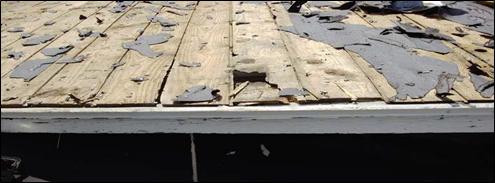
Older deteriorated and damaged deck, board decking. 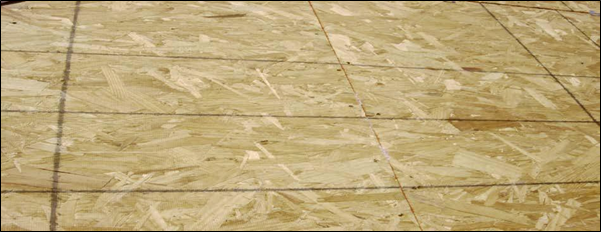
New deck application using oriented strand board, OSB. -
What kind of underlayment should roofers install?
Underlayment may be No. 15 or No. 30 felt, synthetic underlayment, or a self-adhered polymer based modified bitumen material. Windspeed at the site controls, in some cases, when a double layer of underlayment is required. At windspeeds of 140 mph and higher No. 30 felt is required. Make sure roofers install the felt as required by the applicable IBC and IRC standards and the manufacturer’s installation instructions.
-
What kind of roofing nails should roofers use to install shingles?
Roofing nails shall be galvanized steel or stainless steel, minimum 12-gauge, 0.105-inch shank with a minimum 3/8-inch diameter head. The code does not permit staples.
-
How should roofers install asphalt shingles?
Roofers must install asphalt shingles in strict accordance with the manufacturer’s installation instructions on the shingle wrapper. Note: Asphalt shingles can only be installed on roofs with a roof slope of 2:12 or greater.
Standard installation of three-tab asphalt shingle in high wind areas. -
What if I have metal roof panels, metal shingles, or concrete roofing tiles? How should roofers install these products?
Roofers must install the roof covering products in strict accordance with the manufacturer’s installation instructions and their tested high wind applications. TDI has roof covering product listings for many types of roof coverings by many manufacturers. You can find approved product information online or by calling TDI at 800-248-6032.
-
If I want to install, or need to replace my skylights, roof vents, or roof turbines, what do I need to know about getting the right product for my house?
Skylights, roof vents, and roof turbines are vulnerable to high winds and hail. You should choose products that have a published wind resistance rating. For hail prone and hurricane prone regions, choose impact resistant skylights, which are tested to ASTM E 1886 and E 1996. TDI has skylight, roof vent, and roof turbine product listings for many product manufacturers. You can find approved product information online or by calling TDI at 800-248-6032.