

About the report
In 2005, the 79th Texas Legislature passed House Bill 7, which authorized the use of workers' compensation health care networks certified by TDI. This legislation also directed REG to publish an annual informational report card comparing the performance of certified networks with each other, as well as with non-network claims, on a variety of measures including:
- Overall health care costs.
- Utilization of health care.
- Employee satisfaction with care.
- Employee access to care.
- Return-to-work outcomes.
- Health-related outcomes.
In 2021, House Bill 1753 changed the annual publication to a biennial publication.
Published September 2026 by the Workers' Compensation Research & Evaluation Group.
Summary
This report card shows comparative data for network and non-network health care cost and utilization including overall costs for all claims, lost-time claims, and medical-only claims. The cost and utilization are shown for professional, hospital, and pharmacy health care services.
Within this report card, the results from the injured employee survey are included. This survey includes results for network and non-network focusing on the injured employees’ access to appropriate and timely medical treatment as well as their satisfaction with the health care services they received.
The results in this report card show a comparison between 22 networks with a total of 219,941 injured employees and non-network claims with a total 216,371 injured employees. All injuries occurred between June 1, 2023, and May 31, 2025.
Key findings
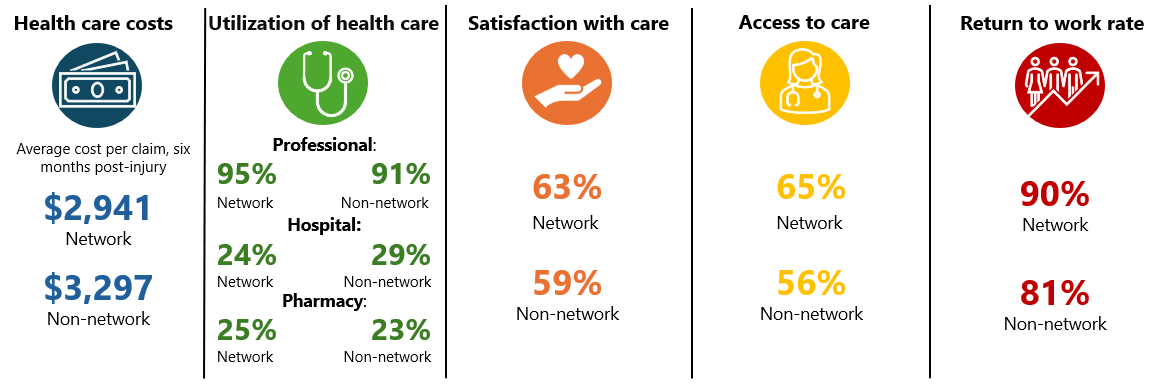
Overall, injured employees within network receive care faster, are more satisfied with their care, return to work sooner, and have lower health care costs.
Health care costs. Networks have lower overall health care costs per all claim types and health care service types than non-network claims at six months. However, several networks did have higher health care costs than non-networks.
Utilization of health care. A higher percentage of network claims received professional and pharmacy services than non-network claims. A higher percentage of non-network claims received hospital services.
Employee satisfaction with care. On average, the level of satisfaction with health care was higher for network than non-network claims with many injured employees reporting higher levels of satisfaction with their treating doctor and higher levels of agreement with their doctors.
Employee access to care. Networks, on average, provided non-emergency care sooner after an injury than non-network claims. Network percentages were higher for injured employees reporting they had no issues getting the care they needed and getting care quickly.
Return to work outcomes. All network claims had higher return-to-work rates than non-network claims.
Additional insights about network results can be found in the technical appendix.